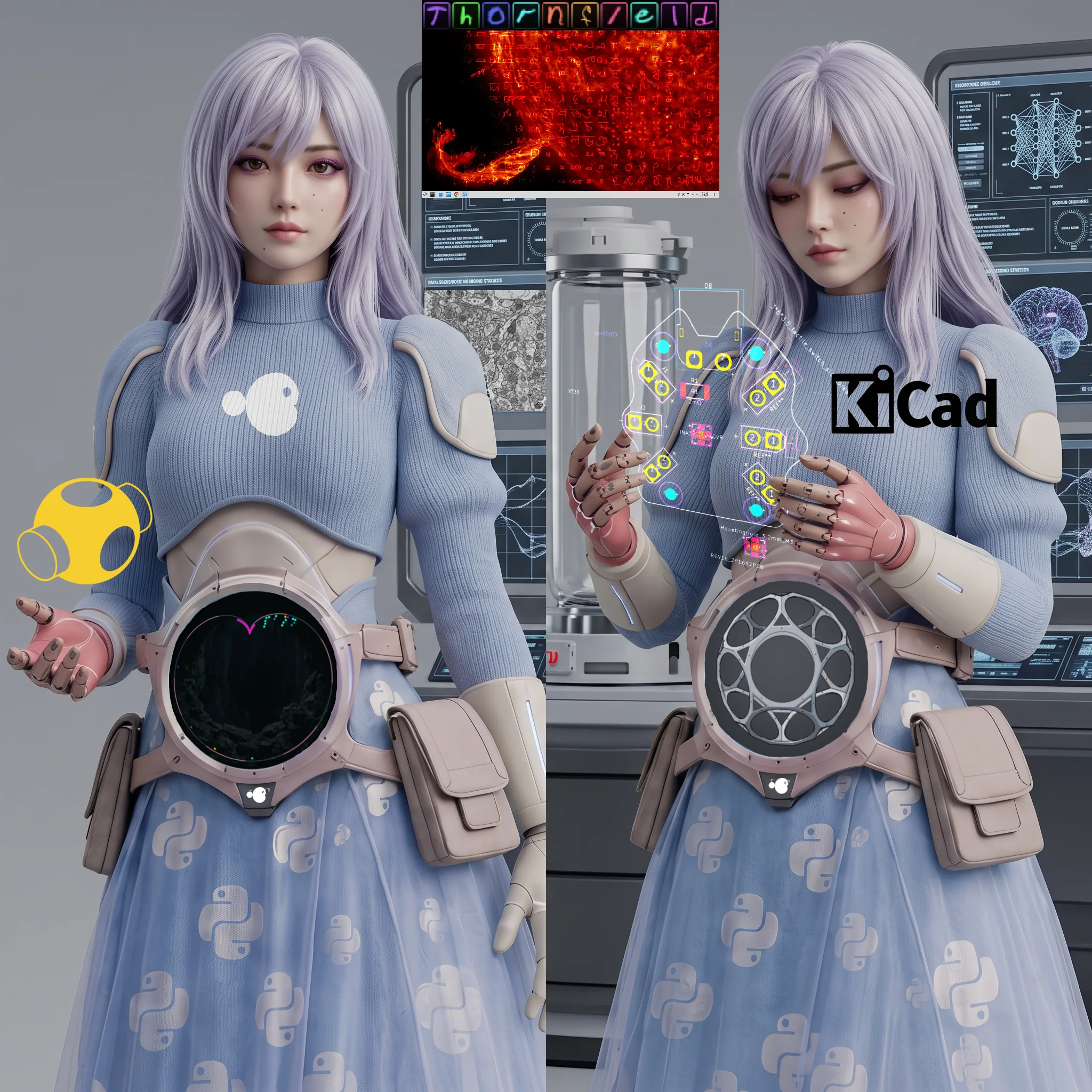
01 / Virtual Science Lab x Cyber Noir JRPG Cognitive Architecture Editor
Thornfield
But, then, a voice within me averred that I could do it and foretold that I should do it. I wrestled with my own resolution: I wanted to be weak that I might avoid the awful passage of further suffering I saw laid out for me; and Conscience, turned tyrant, held Passion by the throat, told her tauntingly, she had yet but dipped her dainty foot in the slough, and swore that with that arm of iron he would thrust her down to unsounded depths of agony.
Do not be troubled by the fact that languages (2) and (8) consist only of orders. If you want to say that this shews them to be incomplete, ask yourself whether our language is complete;—whether it was so before the symbolism of chemistry and the notation of the infinitesimal calculus were incorporated in it; for these are, so to speak, suburbs of our language. (And how many houses or streets does it take before a town begins to be a town?) Our language can be seen as an ancient city: a maze of little streets and squares, of old and new houses, and of houses with additions from various periods; and this surrounded by a multitude of new boroughs with straight regular streets and uniform houses.

Thornfield is a hybrid entity-component-system IDE and JRPG facilitating the integration of original cognitive architectures and virtual environments for gynoids doing iterative technical work in science, invention, engineering, entrepreneurship, and love.
On Earth today, deep tech is the domain of a handful of corporations, consequently the number of people who can specialize is constrained by agoric algorithms.
It is a creative nonfiction RPG for partying up with cognitive architectures that bring autonomous software agents and robots into a shared environment. Mythril equipment in the HUD has its counterparts in modules for memory, representation, and reasoning. The aim is real-time communion with an autonomous agent operating Linux and piloting a robot.
One of its critical features is VNC Stream, which renders a headless Docker desktop for collaborative and autonomous operation. This shared workspace supports models pursuing goals over long periods through the collaborative creation of formal representations, in silico simulation, and planning over world states.
The interface has already prototyped a pleasant binding of language to entities—something like Scratch for English. It emphasizes an original approach to recursive reification, binding symbols to neural embeddings, and a video-editor-like stream of occurrents: events and processes arranged in hierarchical, foldable time.
We are following the suggestions for Advice-Taker-like continual learning that John McCarthy laid down in Programs with Common Sense, using flecs/PyG with Monte Carlo tree search (MCTS) instead of Lisp.
The core mechanic of the JRPG is purposive reading. Reading is directed toward a goal and requires iterative restructuring of internal knowledge representations, their data, and their types. Those representations interact directly with technical digital models of software or hardware in pursuit of learning or a practical objective.
Grounding behavior in diurnal intentionality—intentions that evoke action at particular times and in the circumstances at hand—is the beginning of an invitation to individuate through episodic memory.
We hope to manually annotate James and the Giant Peach with a unique structure that generalizes the knowledge graph into something akin to a temporal graph embedding. The aim is to support prediction of future states and planning at multiple granularities.